Signed in as:
filler@godaddy.com

For nearly four centuries, since René Descartes, much of Western science has followed a powerful method: to understand something complex, break it into its smallest parts.
Reductionism has achieved a great deal. But it can miss what happens when those parts act together, and how whole systems hold their shape, adapt and change.
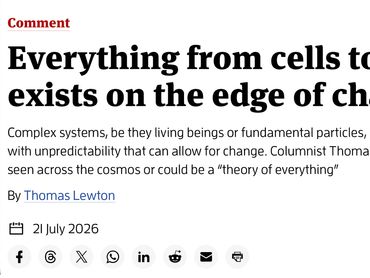
Writing in New Scientist, Thomas Lewton suggests that Dynamic Symmetry Theory is part of a growing effort to look at the whole as well as the parts:
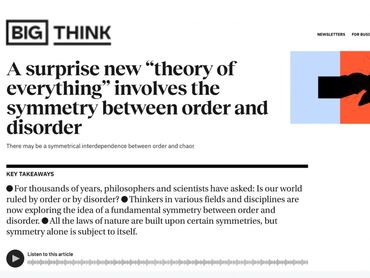
‘Dynamic Symmetry Theory (DST) holds that all complex systems in the cosmos – from living beings to fundamental particles – thrive at the shifting boundary between order and chaos. Here, systems are structured enough to hold them together and unpredictable enough to change…
I’m a fan of DST. It seems to be part of a broader trend among scientists and philosophers to find new lenses through which we can better learn about the world… Rethinking basic assumptions about the behaviour of core concepts like symmetry may well help scientists and philosophers to find the new foundations they seek.’
— Thomas Lewton, New Scientist, July 2026